BMW i7: the EV saloon that sweeps us into the future
Published on 3 December, 2022
MAYBE it is the time of year that got me wondering about where motoring is going.
In the course of test driving this week’s review car, the electric BMW i7 saloon, I tried to imagine what cars, particularly electric, will be like in five/10 years’ time, if they keep pushing out the boundaries as they have done in the course of the last five years.
The key driver, no pun intended, is the combination of electric and digitalisation. That blend has opened up a whole new world.
Overview
MAYBE it is the time of year that got me wondering about where motoring is going.
In the course of test driving this week’s review car, the electric BMW i7 saloon, I tried to imagine what cars, particularly electric, will be like in five/10 years’ time, if they keep pushing out the boundaries as they have done in the course of the last five years.
The key driver, no pun intended, is the combination of electric and digitalisation. That blend has opened up a whole new world.
So, with the Mercedes EQS saloon setting a searing pace on innovation and range (717kms) in the large-saloon class, the i7 is a striking example of how BMW see the future unfolding.
Lots of what I sampled during my drives in the brand’s current flagship will filter down to smaller EVs – and who is the say there won’t be something even larger?
That would be something because this i7 is one big car.
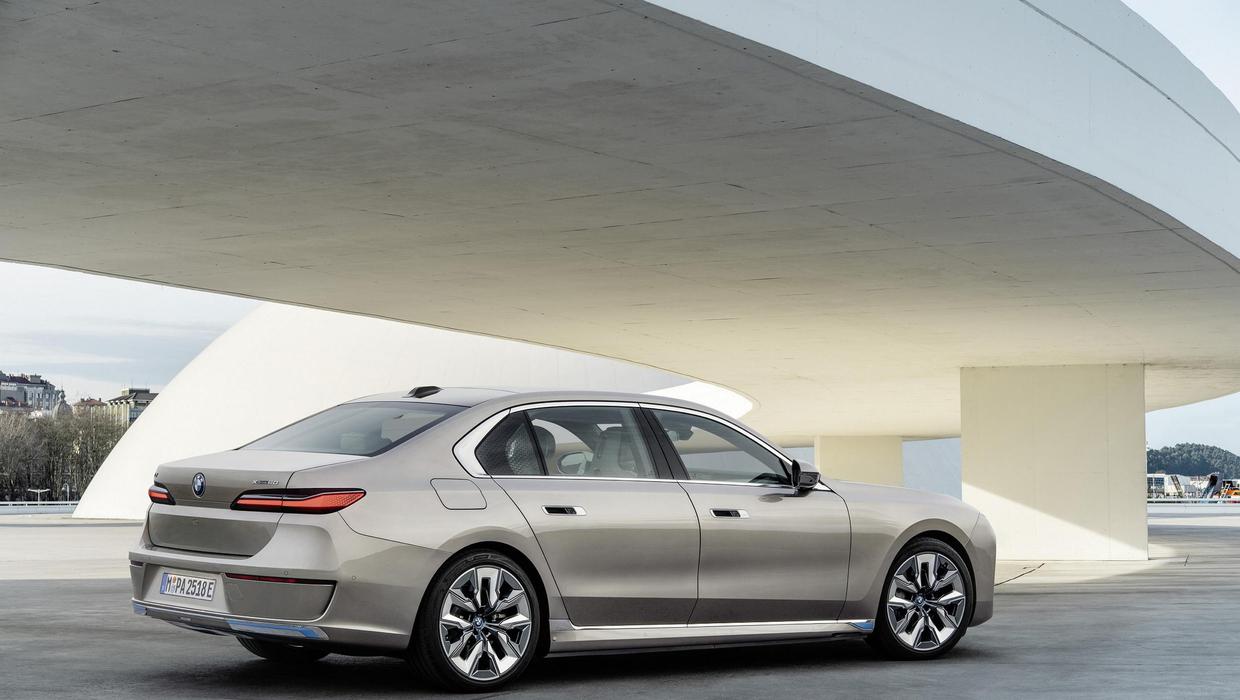
You can’t help but notice it. If you are driving in front of an i7 its kidney grille with its two-piece split headlight units leaves you in no doubt that the car behind is a Beemer. And a big Beemer at that: The 7-series, of which the i7 is part, is 130mm longer (to 5,391mm), up 48mm wider (to 1,950mm) and taller by 51mm (to 1,544mm; headroom noticeably improved). Wheelbase is just 5mm (at 3,215mm).
All that begets an exceptionally roomy cabin: back-seat space is more than impressive, 6ft passengers are spoilt – in more ways than one as we’ll see in a minute.
From a driver’s perspective there’s this huge bonnet way out there. A bit daunting, initially. I was lining up a criticism about huge cars on small roads, but after a couple of drives I dismissed my misgivings as I had adjusted my seat to quite high up so visibility all-round was excellent. Even parking was quite easy – thanks to a variety of hi-tech assists. Big but manageable.
I really relaxed into my drives; broad and supportive leather-clad seats helped a lot.
At the same time I realised there were only a few buttons, controls or switches on the dash – thanks to digitalisation of course.
It uncluttered the dash. Instead, you get 12.3ins information and 14.9ins displays. The screens sit together behind a curvy glass surface that’s tilted towards the driver.
And it heralds the Interaction Bar, a different, and colourful, way to package many elements, including touch-sensitive control panels.
The iDrive Controller on the central console is thankfully straightforward, with buttons (yes there are a few) to adjust the audio system and car functions. So that’s everything under ‘control’ inside.
Underneath is a large, but slim, battery pack that can store 101.7 kWh of usable energy.
There are two electric motors deriving power from the battery pack. A 313hp motor drives the rear wheels, the one on the front axle produces 258hp. That means the car has all-wheel drive and can streak from zero-100kms in 4.7 seconds. While it was quick and responsive on twisty roads due to the air suspension, I felt it was at its smooth and dynamic best on the open road.
I noted numerous ways of energy regeneration, including ‘coasting’ with no drive power when you lift off the accelerator – no battery power is used.
The Combined Charging Unit allows AC charging at a rate of up to 11 kW. DC power can be taken on board at a rate of up to 195 kW. This allows around 170kms of range to be added in just 10 minutes at a high-power charging station. I wish there was one near me, but that’s a different conversation.
Looking a little bit into that future that I was wondering about... there will be two plug-in hybrid models early next year while a more powerful i7 M70 xDrive is due later in 2023
Watch out for one of the ‘highlights’ of the i7’s upcoming options.
It’s a 31.3ins Theatre Screen and due next spring. Yes a 31.3ins touchscreen display with a Bowers & Wilkins surround sound system. It spreads horizontally nearly the full width of the cabin and expands downwards to the front-seat backrests. Movies on the move.
But would I buy the i7? It appealed on a number of fronts, has massive room and comfort but does it beat the Mercedes EQS?
It’s a tough call. The Merc, for example, has a huge range of 717kms versus 625km for the i7. But the Beemer distributes so much power in a hugely, and more, satisfying manner.
So much depends on individual taste. For me it’s the EQs by a whisker. But the future may find me have been wrong.
Factfile
BMW i7 xDrive60 M Sport electric saloon. Tested: €148,336.
Includes following spec: leather upholstery, latest generation of BMW Operating System 8, Curved Display and Interaction Bar, AC charging of up to 11 kW; DC power of up to 195 kW – 170kms of range boost in 10mins at a high-power charging station.
Electric range up to 625kms. Rear motor 313hp, front motor 258hp.
Big array of comfort and driving assist systems.
Interior Gallery

Latest Reviews
Like what you see?

Connect With Us


Our Mobile App