Hyundai throws down EV gauntlet with new IONIQ 5
Published on 25 September, 2021
I have to restrain myself a bit with this week’s review car, the electric Hyundai IONIQ 5. I might say too much and live to regret it.
The fact I had it for just 24 hours also shackles me a little, though you’d be surprised what can be garnered in that time. Yet I doubt, somehow, that more time with it would have radically altered my views.
What you get with this five-door, five-seater ‘crossover’ (it’s more a hatchback on medium stilts with extra ground clearance) is something quite radical. The longer I drove it, the more apparent that became.
Overview
I have to restrain myself a bit with this week’s review car, the electric Hyundai IONIQ 5. I might say too much and live to regret it.
The fact I had it for just 24 hours also shackles me a little, though you’d be surprised what can be garnered in that time. Yet I doubt, somehow, that more time with it would have radically altered my views.
What you get with this five-door, five-seater ‘crossover’ (it’s more a hatchback on medium stilts with extra ground clearance) is something quite radical. The longer I drove it, the more apparent that became.
The IONIQ 5 is Hyundai’s answer to the likes of the World Car award winning Volkswagen ID.4 and the Tesla Model 3. I’d go so far as to say that while the ID.4 and IONIQ 5 match each other stride for stride in many departments, the Hyundai has something few cars have these days – real ‘emotional’ appeal.
Yes, there are some hard plastics in the cabin and maybe the ID.4 is a bit more dynamic in terms of handling, though the Hyundai did well on ride comfort. And maybe there is a little bit of switch clutter to the right of the steering wheel where I thought the gear handle was slotted too low and close to the windshield wiper stalk.
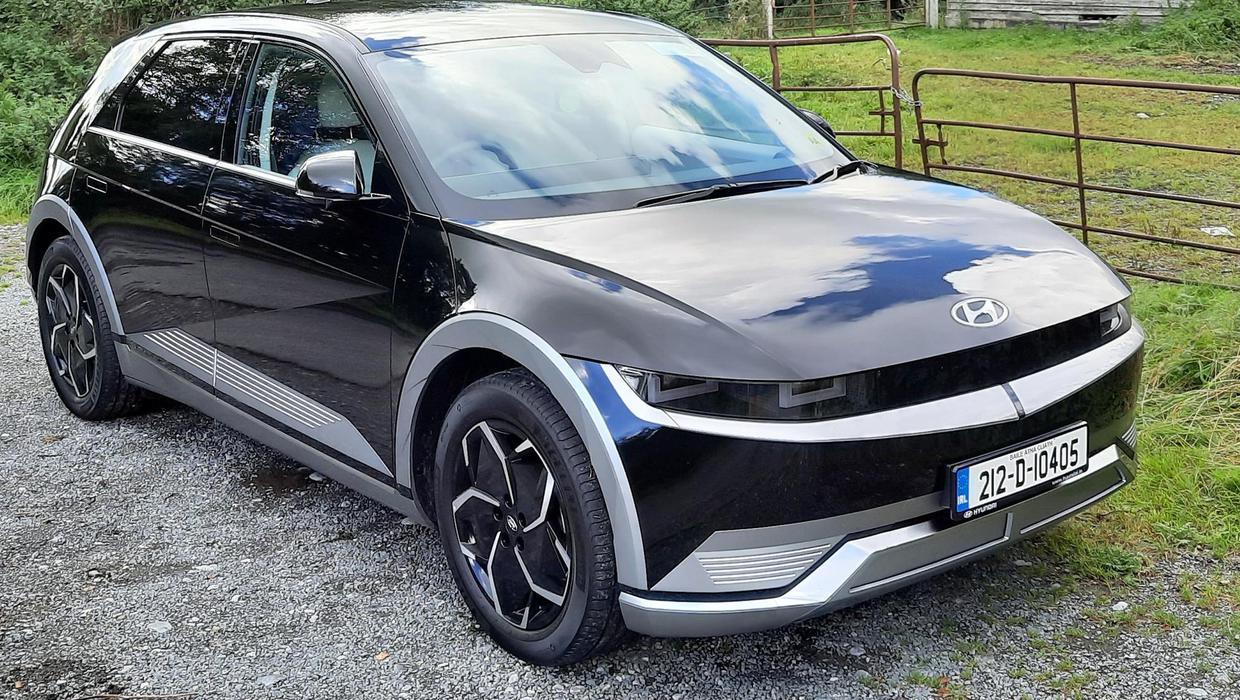
But I’d leave most of that to one side in favour of the daring nature of design and application. Take those extraordinary 19-inch wheels. They’re like something you’d see on a concept car at a motor show that the sceptics among us would dismiss as fantasy stuff. Indeed, I could say lots of things in this car look like they might have been made to be aspirational rather than the functioning entities they are.
This is one of most striking looking cars (inside and out) for the money I’ve come across in a long time.
Let’s start at the front, where the clamshell bonnet sets off myriad design slivers across the grille, light clusters and front flanks. The side hints at SUV/crossover roots and the rear, with its sweeping, sloping rear glass is a stand-out example of thinking about how to do things differently.
It’s a car you’d want to look at. Inside, it was a car I liked to sit in. It was equally eye-catching, with the huge display on the dash of two 12.3-inch screens setting the tone of designed practicality, and interactivity, amid all that space.
Yet, with everyday functions in mind they made productive use of ‘piano keys’ (buttons) on the ledge beneath the display for ventilation and air conditioning.
The fact that the floor is flat helps the feeling you are sitting in something far roomier than it looks from the outside. I acquired a great driving position; not as high as your ordinary SUV/crossover but it bestowed a reassuring vista of visibility. By the way, you can recline the front seats to be nearly fully flat.
The boot didn’t look that roomy but officially it’s 540litres, which is neck and neck with the ID.4. And there is a 57litre ‘frunk’ under the bonnet.
There was plenty of storage too in and around the centre console; and USB ports and a wireless phone charger.
All this space (‘the rear is of limousine capacity’ I wrote in my notes) is largely due to the company’s E-GMP platform which, in this case, maximises interior space thanks to its 3,000mm wheelbase and short overhangs front and rear. We’ll be hearing a lot more about that platform as it will underpin large numbers of EVs, including 11 dedicated models by 2024. And there will be an IONIQ 6 and 7 to accompany the 5. All part of aiming for sales of more than one million battery EVs worldwide by 2025.
I suppose it’s time to pose the ultimate question: how did it fare on the road? It drove well and was extremely quiet with no thud from the tyres.
The 58kW battery version tested, with its four drive modes, has a claimed range of 384km. There is a more powerful 72.6kW version with longer range.
My test car had 332km in the battery when I started; the system indicated that was 99pc of capacity. I drove 263.4km overall and had 62km left (19pc), so it was quite accurate and ‘honest’ about its energy use.
A reason to be really impressed with that return was down to the fact I didn’t drive much in urban environs where EVs tend to be more frugal.
Also helping keep the consumption down a bit was the on-board heat pump to take the strain and onus from the battery pack.
The IONIQ 5 has a huge spread of safety, comfort technology and driver assists, I’d need 24 hours to detail them. And the good thing is most are on lower-to-mid spec models.
So would I buy it? With an unrestrained Yes, I would. Watch out Tesla and VW and others: Hyundai is coming at you.
Interior Gallery

Latest Reviews
Like what you see?

Connect With Us


Our Mobile App