A seven up with the best as Mercedes delivers one of the safest, quietest, coolest cars
Published on 10 April, 2022
Waves of nostalgia flow every time I test a seven-seater car. It goes back to many years ago and owning a Saab 95, the estate version of the rally-proven 96.
Just like that iconic motor, it only had two side doors but was blessed with a pair of extra rear-facing seats that pulled up from the floor in the load area. They were accessed by climbing in when the large rear hatch was raised.
Overview
Waves of nostalgia flow every time I test a seven-seater car. It goes back to many years ago and owning a Saab 95, the estate version of the rally-proven 96.
Just like that iconic motor, it only had two side doors but was blessed with a pair of extra rear-facing seats that pulled up from the floor in the load area. They were accessed by climbing in when the large rear hatch was raised.
Those two seats had a lineage that stretched back to the old ‘dickeys’, sometimes called ‘mother-in-law’ seats, of the early roadsters. They in turn evolved from the need to sometimes have space to carry an extra servant in those first ‘horseless carriages’.
What fun was had in the 1970s packing seven of us into the Saab and going off on excursions around the north of England. Children and my child-like friends had much sport making faces at following cars.
It eventually came with me to Ireland and seemed to be the only one in the country. Of course it probably was a safety horror story waiting to happen — no seat belts and little protection.
These days there are no such problems. The rear row in most of the seven-seaters still might pull up from the floor but are now front-facing and have their own seat belts. However, they still need a fair bit of the agility that was necessary to get into the boot of the Saab.
Much of that skill has deserted me, so I tend to leave the accessing of the rear seats to people smaller and more supple. In fact, with very few exceptions — and then you are heading in van-like directions — they really are usually only for children.
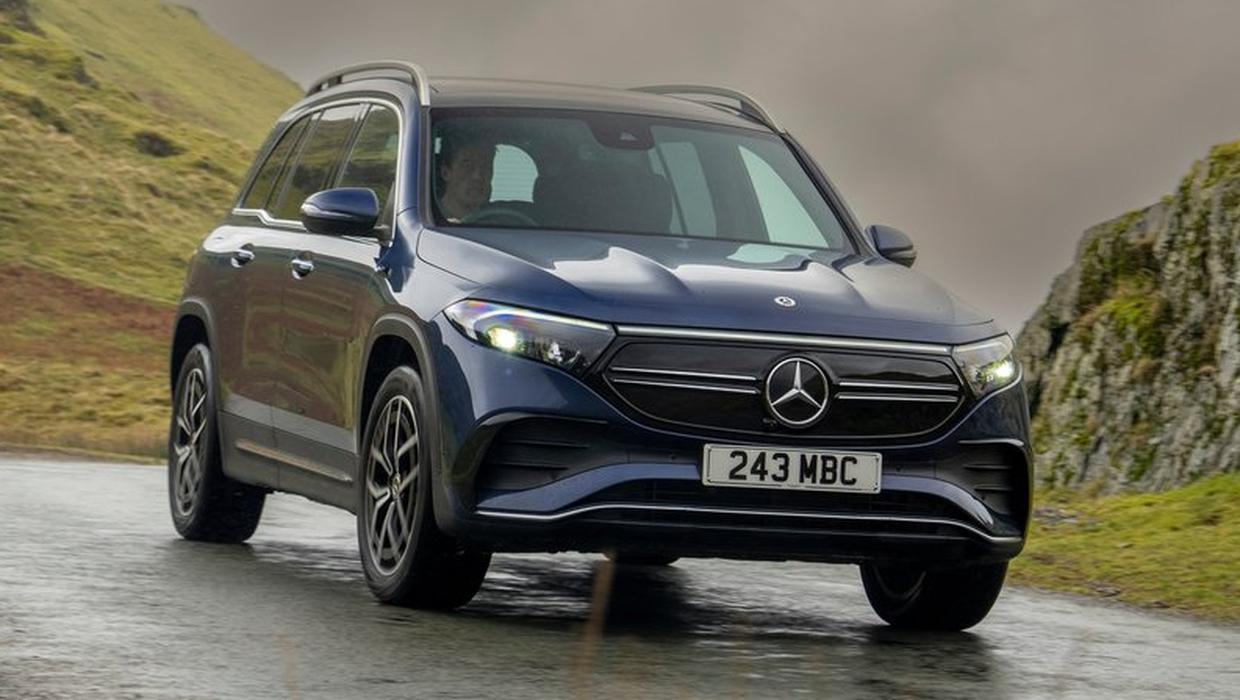
That said, it was quite delightful to have a chance to test the Mercedes-Benz EQB 300 4Matic, a pretty compact, fully electric seven-seater which is almost unique among the traditional premium brands.
Of course, much larger SUVs like the BMW X5 have seven-seater options but the EQB, like the conventionally powered Mercedes GLB, goes for a lot smaller dimensions.
The Peugeot 5008 and Hyundai Santa Fe are both near-premium models that offer seven seats in very attractive packages. The EQB stands tall and looks practical rather than being a creature of beauty. In this it is rather reminiscent of the older, much-loved Subaru Forester.
It is exceptionally well built, both inside and out and, courtesy of the 228hp driving all wheels, is a very safe and confident drive.
It isn’t blisteringly fast — it will do 0-100kmh in eight seconds, but keeps its top speed to just 160kmh. That helps to give a claimed range of 419km. However, that’s wildly optimistic.
Fast-charging stations will take you from 10pc to 80pc but it took more than 12 hours to go from 32pc to 90pc using my 11kW wallbox at home.
While the price for the EQB 250 (front wheel drive option) starts at €64,030 and the 300 4Matic at €68,505, just a few clicks on the extras package will head you toward €80k.
Yet even on the ‘basic’ versions the standard of safety equipment is absolutely first class and, unlike in my 1970s Saab, your little darlings will be totally protected.
The EQB felt like one of the safest, quietest, coolest and most relaxing cars to drive. With the rear-most seats folded down it has great carrying capacity.
Passengers in the middle row can slide the split 60-40 seats to give greater or less legroom. However, the batteries under the floor make the sitting position slightly awkward.
Up front there are no such issues, with lots of comfort and good infotainment. The EQB is a heavy machine, which despite its EV credentials would probably be on Eamon Ryan’s SUV hit list.
That said, I loved driving it and found it so easy to manoeuvre and live with. If the price frightens — and perhaps it should — there’s a seven-seater petrol Dacia Jogger which is getting a lot of plaudits at €23,290.
It’s been a good start to the year for Kia. Not only did its all-electric EV6 win the European Car of the Year title, but that car and good sales for the Sportage in the last three months have pushed the Korean manufacturer to a 7.75pc market share for the first quarter of the year.
This represents a record share for the company. In a flat market up just 4pc from 2021, Kia is up 35pc and is third ranked behind market leaders Toyota and Hyundai.
Kia Ireland’s results follow a strong performance by the brand throughout Europe, in which Kia’s market share grew impressively to reach 5.3pc.
Ronan Flood, managing director of Kia Ireland, said: “Quarter One, 2022, is certainly a milestone for the Kia brand in Ireland with a historic third place in the market. Kia has faced the same supply problems as other manufacturers but we are delighted to have pushed out nearly 4,000 units to dealers and customers.”
The good results came as Kia also announced more details of the totally revised Niro, which arrives here as a plug-in hybrid in time for July and an EV later in the summer. I think it is going to be a very exciting launch.
Already the existing model is a standout car. Which? car guide says it is the only new EV that has earned a reliability rating of five stars and is also the most reliable car in the small SUV class across all fuel types. I know some very happy owners.
It was my wife’s birthday last week and I am running out of time when help toward a new car can be avoided.
The new Niro or, later next year, its sibling the new Hyundai Kona, are favourites to have red bows put around them eventually. They are both bigger and smarter.
Interior Gallery

Latest Reviews
Like what you see?

Connect With Us


Our Mobile App